Standing Desk vs Solid Wood Office Setup: A 5-Year Cost Comparison for Singapore Homes (Veneer vs Solid Wood)
I moved into a 4-room HDB flat in Tampines last year, and within three months I had already replaced my study desk twice. The first one was a veneered particleboard standing desk I found on Carousell for SGD 189. The motor burned out in eight months. The second, a locally assembled unit at SGD 329, sagged at the height-adjust joint after fourteen months of daily 9-to-6 use. By the time I started hunting for a third option, I had spent roughly SGD 518 on desks that no longer worked, plus another SGD 80 in carpentry to patch the cable channels they had chewed through. That is when I drove down to a MIDHILL showroom with a tape measure, a notepad, and a very specific question: is the jump from veneered engineered wood to solid wood actually worth it over five years, or is it just marketing?
If you live in a Singapore HDB flat or a condo in Bedok or Punggol, you already know the constraints. Lift openings are typically 90 cm wide and 210 cm deep. Corridors in newer BTOs run about 1.2 m. Ceiling heights hover at 2.4 m for resale flats, 2.7 m for some newer condos. Every piece of furniture you buy has to work through that geometry, often flat-packed, often carried up three flights because the lift is occupied. Price matters. Space matters. Durability matters. So does the 9% GST you pay on top of every receipt.
What does a standing desk actually cost over 5 years in Singapore?
A standing desk over 5 years in Singapore typically costs between SGD 900 and SGD 4,200 once you include the desk, a matching chair, maintenance, and two replacements on the cheap end. A veneered engineered unit rings up at SGD 189 to SGD 450 for the frame and tabletop, and you will likely replace the motor or the whole desk at least once. A solid wood unit from a maker like MIDHILL sits between SGD 1,100 and SGD 2,800 for a comparable height-adjustable setup using oak or ash, and it normally needs zero structural replacement across the same window. When you add a solid wood sofa for the living area, a bed frame for the master bedroom, a dining table for four, a two-door wardrobe, and a pair of nightstands, the five-year spend can stretch from SGD 7,000 on the veneer path to SGD 22,000 on the solid wood path. The gap looks wide at the register. Spread over sixty months, it works out to roughly SGD 117 versus SGD 367 a month, and that gap is where the real comparison lives.
Is veneer really cheaper, or just cheaper-looking?
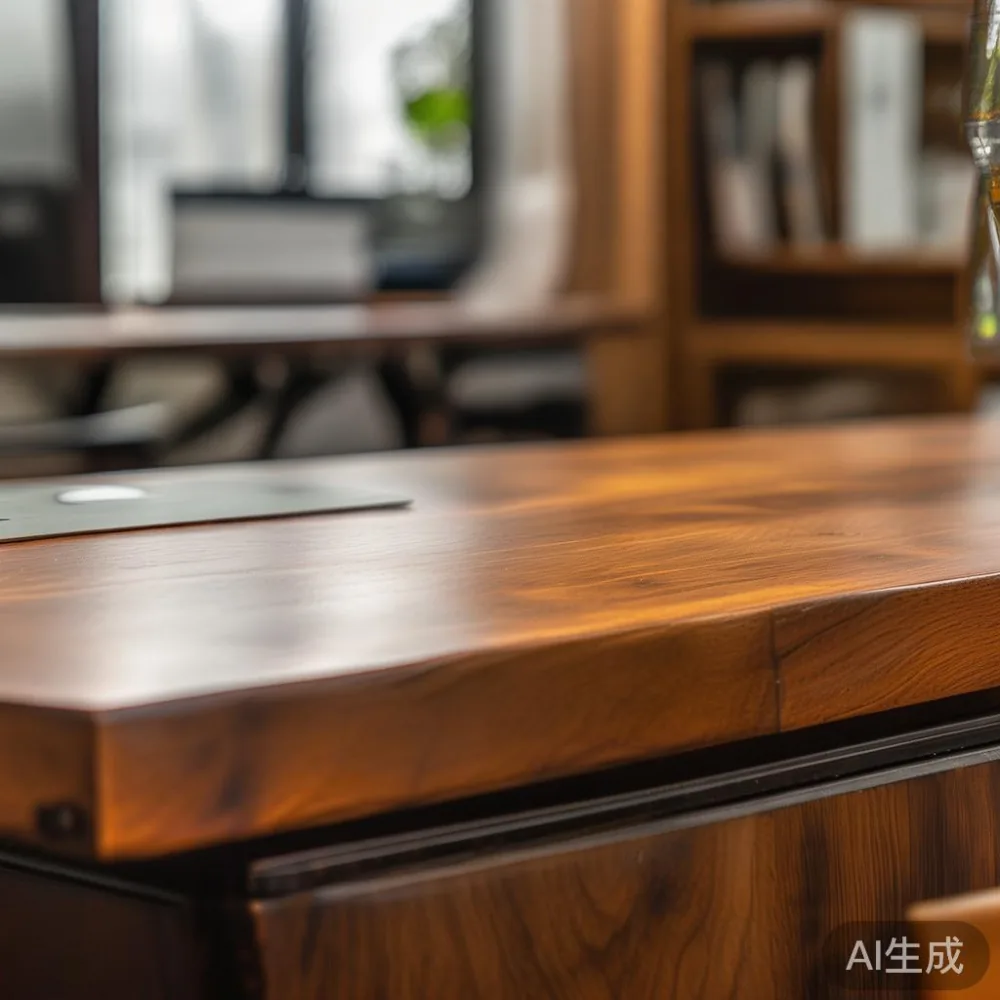
Veneer is genuinely cheaper at the point of sale. A 120 cm x 60 cm veneered tabletop with an electric lift frame sells in Singapore for SGD 220 to SGD 380 at places such as Courts, Harvey Norman, or the many local assemblers in Tai Seng. A 120 cm x 60 cm solid oak or ash tabletop with the same lifting mechanism, plus the heavier duty frame required to handle the additional 12 to 18 kg of real timber, runs SGD 1,150 to SGD 1,900. The sticker shock is real. What is less visible is what happens in months 13 to 24. Veneer is a 0.5 mm to 2 mm slice of decorative wood glued onto a substrate, usually MDF or particleboard. In our humidity, which hovers between 70% and 85% RH year-round, the substrate swells at a different rate than the veneer face. You see it first at the edges as a pale ridge, then as peeling at the cable cutout, then as bubbling near the keyboard tray.
Last month I visited a colleague's three-bedroom condo in Punggol and saw exactly this on his SGD 269 standing desk. The MDF core had swollen at the rear corner where his aircon condensate line dripped. The electric motor still worked, but the surface had bowed by 4 mm across 60 cm, enough to make his laptop wobble. He was month 18 into ownership. He had paid for the desk, the GST, the SGD 40 delivery up three flights, and now he was looking at a replacement. His five-year projection, if he sticks to the same tier, is two desks (SGD 538), one mid-cycle repair (SGD 120), and one tabletop replacement (SGD 90). Total: SGD 748 for the standing desk alone, before chair, sofa, or bed.
Is American country king bed furniture worth it?
Yes, American country king bed furniture is worth it for Singapore homes when it is built from solid wood, because the king bed format magnifies every weakness a veneered frame has. A king bed measures 183 cm x 190 cm internally, with an external footprint close to 200 cm x 215 cm once you add a headboard and side rails. That is a 4.3 sqm footprint inside a room that, in a typical HDB master bedroom, is only about 16 sqm. The bed takes more than a quarter of your floor. If the side rails bow, the slats crack, or the headboard delaminates, you do not just lose sleep, you lose usable square footage while you wrestle a replacement in. A solid wood American country king bed frame, built from oak, ash, or a green walnut bed frame with hand-finished joins, holds its geometry for 10 to 15 years in our climate, and it can be refinished rather than replaced. A particleboard king bed at SGD 1,500 to SGD 2,200 looks identical on day one and starts failing in year three.
How does light luxury positioning change the math?
Light luxury, whether you call it French light luxury, American light luxury, or the post-modern light luxury variant popular in Seoul and Tokyo showrooms, is a design register that sits between flat-pack IKEA minimalism and full Old World ornament. It uses restrained profiles, soft-close joinery, marble accents on a side or dining table, and a palette of warm whites, sand, and tobacco. In Singapore, this register is associated with condos in the OCR such as Treasure at Tampines, Bedok Residences, or Punggol Waterway, where the standard of finish is visibly higher than in older HDB flats. Furniture that matches this register tends to be solid wood by default, because the whole point of the look is that you can see, and feel, the grain. Veneer cannot honestly deliver that. A solid wood sofa in oak or ash, a marble table with a solid wood base, a wardrobe in white-oiled ash, and a pair of solid wood nightstands will read as light luxury. The same items in MDF with a photo finish will read as a budget compromise the moment a guest runs a hand across the surface.
Here is the cost translation. A post-modern light luxury solid wood sofa in a 3-seater runs SGD 3,800 to SGD 6,200 in Singapore, against SGD 1,400 to SGD 2,400 for a veneered equivalent. A solid wood dining table for six in oak runs SGD 2,200 to SGD 4,800, against SGD 900 to SGD 1,800 for veneer. A solid wood two-door wardrobe, around 180 cm x 60 cm x 210 cm to fit a standard HDB recess, sells at SGD 3,200 to SGD 5,400, against SGD 1,100 to SGD 2,000 for engineered alternatives. The light-luxury tier assumes you will not replace these pieces every five years. The math is built on a 10 to 15 year horizon, with one or two rounds of refinishing in the middle.
What are the hidden five-year costs nobody talks about?
The hidden five-year costs are delivery, disposal, downtime, and refinishing. Delivery in Singapore for a flat-packed veneered standing desk is usually SGD 40 to SGD 80, with free shipping over a threshold. Delivery for a solid wood standing desk is heavier, typically 60 to 90 kg packed, and runs SGD 120 to SGD 220, though MIDHILL absorbs this for orders over US$350 equivalent and ships the piece into your flat, including the lift and corridor maneuvering. Disposal is the cost nobody prints. A bulky veneered desk that has delaminated cannot be donated through most HDBecycle or NGO channels because the MDF core disqualifies it. A solid wood piece, even one that has been refinished several times, can usually be donated, resold on Carousell for 30% to 50% of original, or repurposed. Downtime matters if you work from home. A desk that fails in month 18 means two to four workdays lost to sourcing, delivery scheduling, and assembly. At a SGD 25 to SGD 60 hourly rate for a knowledge worker, two lost days is SGD 200 to SGD 960 in opportunity cost.
Refinishing is where solid wood quietly wins. A solid wood dining table can be sanded and re-oiled in your home for SGD 280 to SGD 450, and the room is usable the same evening. A solid wood sofa frame, the structural skeleton under the cushions, can be refinished in place. A solid wood bed frame, including a green walnut bed frame with a headboard, takes a coat of hard wax oil and looks new again for under SGD 200 in materials. Veneer cannot be refinished. Once the 0.6 mm face layer is through, the substrate is exposed and the piece is finished. Lifetime refinishing, which MIDHILL offers on its solid wood pieces, is the single line item that flips the five-year economics for buyers who keep furniture a decade.
How does a Singapore home actually use a standing desk long-term?
A standing desk in a Singapore home is rarely used the way the marketing videos suggest. You will not stand for eight hours. You will sit-stand through a nine-hour block, averaging 40 to 90 minutes of standing per day, with the rest seated. The motor will cycle 8 to 14 times a day, which works out to roughly 14,000 to 25,000 cycles over five years for a work-from-home user. Entry-level electric frames are rated for 10,000 cycles. Mid-range frames handle 25,000 to 40,000. Solid wood tops do not add meaningful cycle load, but they do add 12 to 18 kg of mass, which is why the frame spec matters more than the tabletop spec. Pairing a SGD 120 frame with a 22 kg ash top is a five-year failure waiting to happen. Pairing a SGD 350 to SGD 500 frame rated for 50,000 cycles with a solid wood top is a setup that will outlast two laptops.
Measure twice, order once. The HDB study nook in a 4-room flat is typically 1.8 m x 1.2 m, sometimes smaller. A 120 cm x 60 cm standing desk fits with 30 cm of clearance on each side for a chair, a cable channel, and a monitor arm. A 140 cm x 70 cm standing desk fits only if you push the chair fully under, which means your knees hit the rear modesty panel every time you stand. In a condo study that opens onto the living area, you can go larger, 150 cm x 75 cm or even 180 cm x 80 cm, and you can add a solid wood return at 90 degrees for a printer and a marble table lamp base. The geometry is forgiving. The weight is not. A 180 cm x 80 cm solid ash top weighs 38 kg before the frame. Plan for two people on delivery day.
So, veneer or solid wood for the next five years?
For the next five years, the honest comparison is this. Veneer wins on day-one price and loses on every other line item. A SGD 250 veneered standing desk that fails in month 18 costs you SGD 500 across the window once you add the replacement. A SGD 1,400 solid wood standing desk that is refinished once at month 36 costs you SGD 1,580 across the window. The gap on day one is SGD 1,150. The gap at month 60 is SGD 1,080. Across the same window, you have spent less, you have produced less e-waste, and you have a desk that still works. Multiply that logic across a solid wood sofa, a bed frame, a dining table, a wardrobe, and a pair of nightstands, and the five-year savings on the veneer path turn into a five-year premium on the solid wood path that you pay exactly once, in a single receipt, rather than in a steady drip of replacements and repairs.
If you are furnishing a new BTO in Punggol or a resale flat in Bedok, my suggestion is to spend the standing-desk budget on a solid wood top and a frame rated for at least 40,000 cycles, then spend the savings you would have wasted on a third replacement on a solid wood dining table and a marble table for the entryway. Pick one anchor piece per room, build around it in veneer if you must, and refinish the anchor piece in year four. That is the path I am taking with the MIDHILL showroom near me, and the spreadsheet says I come out ahead by month 54.