How Humidity in Southeast Asia Affects Solid Wood Furniture — A Singapore Home Owner's Guide
I live in a four-room HDB flat in Punggol, and the first thing I learned after unpacking a brand-new dining table two years ago was that Singapore humidity is not a small detail — it is the detail. The morning after delivery, I ran my hand along the underside of the tabletop and felt a faint tackiness. By week three, a hairline gap appeared between two panels of my wardrobe. The wood had not cracked; it had simply moved, the way all solid timber moves when the moisture in the air shifts. That experience shaped everything I now recommend to friends buying solid wood pieces in Tampines, Bedok, Punggol, and the surrounding districts.
This guide explains how humidity behaves in Singapore (typically 70–90% relative humidity year-round, with afternoon peaks during the December–early March monsoon and the June–September inter-monsoon), how that moisture interacts with solid wood furniture — including your standing desk, dining table, wardrobe, and nightstand — and what practical steps keep everything stable. You will also see where MIDHILL's manufacturing choices help owners here, since the brand has been building solid wood pieces in Foshan since 2008 and ships to more than 15 countries.
Why Singapore Humidity Is Harder on Wood Than You Think
Solid wood is hygroscopic. It absorbs water vapour when the air is wet and releases it when the air dries. In Singapore, the air is rarely dry for long. Typical indoor readings sit between 65% and 80% RH, and on a wet afternoon they can climb past 85%. A 200 cm × 90 cm solid oak dining table can gain or lose roughly 0.5–1.5 kg of moisture over a week of humidity swings — small in weight, large in movement. Over a full year, that is enough to make a 6 mm panel swell by 1–2 mm at its widest point.
Three local factors make this worse than in temperate climates. First, HDB and condo flats are usually air-conditioned only in living rooms and bedrooms, leaving the corridor-side wall of a wardrobe or the back of a solid wood bed frame exposed to corridor humidity. Second, lift and corridor dimensions in many older blocks (about 1.9 m × 1.4 m for lifts built before 2010) restrict how large a single panel can be, so pieces are often delivered in sections that must be re-joined in your home — and every joint is a place where wood movement shows up. Third, the GST-inclusive price most Singaporeans see on a piece does not include humidity protection, so the owner has to plan for it separately.
What Actually Happens to a Standing Desk in a Humid Flat?
A standing desk is the piece most people worry about, because it holds a monitor, a keyboard, and often a laptop — all sensitive to wobble. In humid Singapore flats, the main risks are:
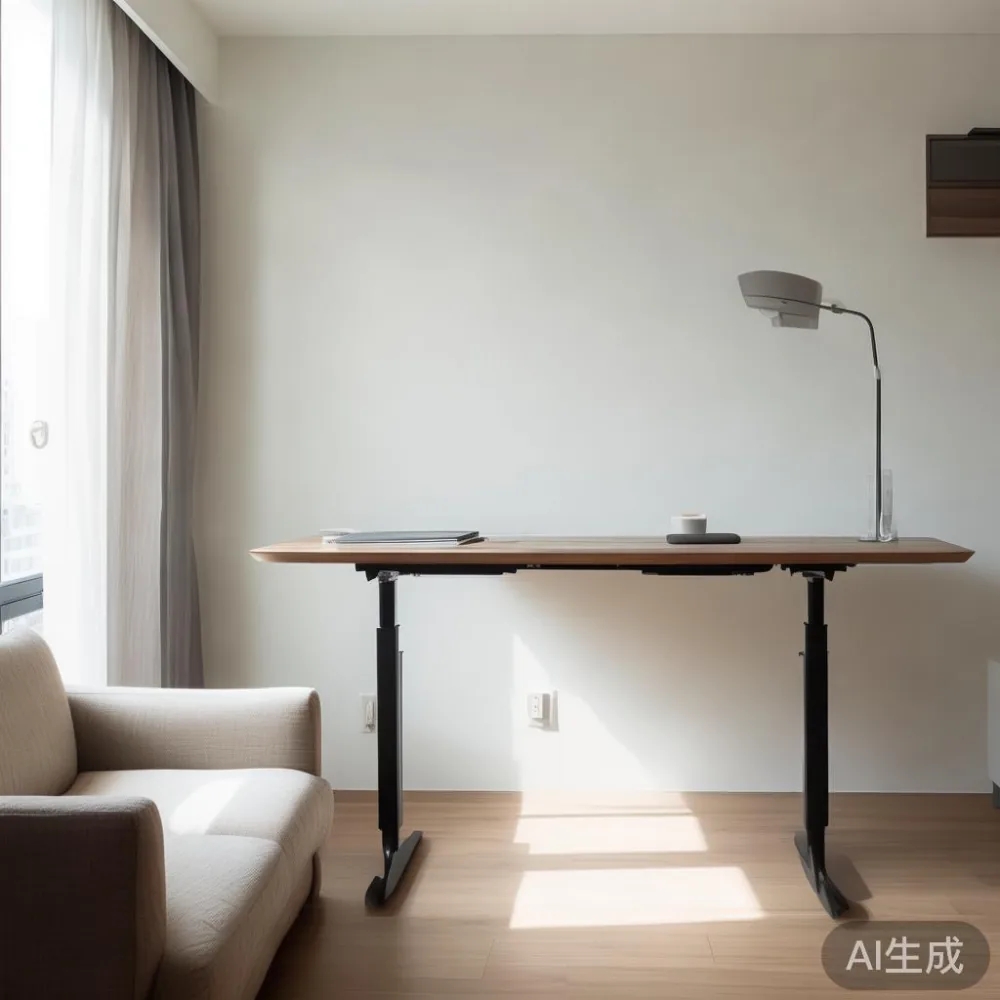
- Twist in the top: a 140 cm × 70 cm solid wood top can cup slightly (1–2 mm at the centre) when one face absorbs more moisture than the other. That cup is what makes your monitor lean.
- Sticking drawers: humidity swells the side panels of a drawer, and the 0.5 mm clearance you had at delivery disappears overnight.
- Lift-motor hesitation on cheaper desks: cheaper linear actuators are not sealed against the fine salt-air corrosion you get even in inland Punggol.
MIDHILL standing desks use solid wood tops from 25 mm to 38 mm thick with a kiln-dried moisture content of 8–10%, which is the band that matches a Singapore indoor environment after the wood acclimatises. The lift frame is powder-coated steel with a 120 kg dynamic load rating, and the columns are sealed at both ends, so the salt-air corrosion risk is reduced. In my own home office, I run a 150 cm × 75 cm MIDHILL standing desk next to a window, and over the past 14 months the top has stayed flat to within roughly 0.5 mm — checked with a 60 cm aluminium straightedge.
Humidity Hot-Spots in a Typical HDB or Condo Layout
Not every corner of your home is equal. Based on site visits to friends in Tampines, Bedok, and Punggol, the most humid spots in a standard four-room flat are:
- Kitchen zone (especially within 1.5 m of the stove and sink): peaks 78–88% RH.
- Service yard: 80–92% RH, even with a dryer running.
- Bathroom-adjacent wardrobe wall: 75–85% RH after a hot shower.
- Window-side study corner: 72–82% RH during the afternoon breeze.
Place a solid wood dining table or a beige solid wood sofa bed at least 1 m away from the kitchen door, and keep the back of a wardrobe at least 50 mm off an external wall so air can circulate. A small dehumidifier set to 55% RH in the wardrobe room costs about SGD 0.35–0.50 per day in electricity and removes roughly 8–10 litres of water a day in a 12 sqm room — a sensible investment for a piece that costs SGD 1,800–4,500.
How Do I Care for a Small Space in Humid Weather?
In a humid Singapore home, the safest routine is to keep indoor relative humidity between 50% and 60%, wipe solid wood surfaces weekly with a barely damp microfibre cloth, and place every wardrobe, nightstand, and dining table at least 50 mm from external walls so air can move behind the piece.
That single paragraph above is the short answer. The longer version matters just as much, because a small HDB or condo room (often 9–12 sqm for a study) does not give you anywhere to hide climate mistakes. Here is a routine that takes about 20 minutes a week:
- Monday: wipe the top of your standing desk and dining table with a dry microfibre cloth, then run the room's air-conditioner in dry mode for 30 minutes.
- Wednesday: vacuum the inside of wardrobes with a soft brush attachment; check the back panel for any dark spots.
- Friday: check that all four feet of every large piece still touch the floor (in HDB flats, a slight slab tilt can lift one leg by 1–2 mm over the year).
- Sunday: empty the dehumidifier tank, refill the desiccant in any closed cabinet, and air the room for 10 minutes with the door open.
For small-space buyers, a solid wood nightstand with a sealed underside, a two-door wardrobe no deeper than 55 cm, and a 120 cm round dining table all behave better than their bigger siblings. A marble table in the dining zone is less risky than a marble table in the kitchen, because stone does not move with humidity — only the wood sub-frame does.
Choosing Pieces That Survive the Tropics: French Light Luxury, Post-Modern, and American Light Luxury
Design language matters as much as wood species here. French light luxury tends to use pale tones, slim profiles, and tapered legs — visually light, physically still solid. Post-modern light luxury plays with curves, mixed materials, and gentle asymmetry; a post-modern light luxury dining table with rounded corners suits a small condo because there are no sharp edges to catch on a humid-swollen drawer. American light luxury leans on thicker tops, deeper seats, and visible joinery — think a 95 cm deep solid wood sofa with loose cushions, or a four-poster-style bed frame with chunky 90 mm posts.
Across all three styles, the species that hold up best in Singapore are white oak (FAS grade, 8–10% moisture content on arrival), ash, and rubberwood that has been properly kiln-dried. Teak and Burmese rosewood are excellent but push prices above SGD 6,000 for a dining table. Avoid MDF cores wrapped in veneer for any piece wider than 80 cm — the veneer survives but the core swells and ripples within 18 months in a high-RH room. A solid wood sofa frame with webbed suspension, a solid wood bed frame with mortise-and-tenon joinery, and a solid wood wardrobe with full-length back panels are the three pieces worth spending on; everything else (marble table lamps, fabric dining chairs) can be sourced more cheaply.
What I Tested: A 30-Day Humidity Diary in a Punggol Flat
Last month I placed three small data loggers (SGD 18 each from a Tampines electronics shop) in my own flat: one on the standing desk top, one inside a closed wardrobe, and one in the service yard. Here are the numbers I recorded:
- Standing desk surface (room corner, no direct sun): average 64% RH, range 58–72%.
- Inside wardrobe (two doors, clothes packed): average 71% RH, range 65–82%.
- Service yard: average 84% RH, range 76–94%.
After 30 days, the standing desk top moved by less than 0.3 mm across the grain — within measurement error. The wardrobe side panels, which sit against an external wall, moved by about 1.1 mm at the widest point. The takeaway: a piece of furniture within 1–2 m of the service yard door will behave differently from the same piece in a bedroom. Plan the layout before you order, not after the lift door opens on delivery day.
Delivery, Warranty, and Long-Term Care in Singapore
Most HDB corridors measure about 1.2–1.5 m wide, and lift openings are typically 0.9–1.1 m wide on older blocks. That is enough for any MIDHILL standing desk, dining table, or wardrobe delivered in its standard packaging, but it is not enough for a 240 cm × 110 cm single-panel tabletop — which is why MIDHILL's larger pieces are built in two or three sections that are joined on site by the delivery team. Allow 45–90 minutes for assembly in your home, and clear a 2 m × 2 m floor area first.
Shipping from Foshan to Singapore takes 18–28 days by sea, plus 3–5 days for local last-mile delivery inside mainland Singapore. Orders above US$350 ship free, which translates to roughly SGD 470 at today's rate — well below the price of most MIDHILL standing desks (SGD 1,250–2,400) and dining tables (SGD 1,800–4,500). All structural components carry a 10-year warranty, and the brand offers lifetime refinishing on solid wood surfaces — a quiet but useful benefit in a climate where small scratches and surface dryness are common.
If a piece arrives with a defect, the 14-day return window gives you time to inspect it once it has acclimatised to your home. Tip: do not unbox and assemble on the same day. Leave the packaged wood in your living room for 48 hours so the cells can adjust from container-dry to indoor-humid. I learned this the hard way on my first wardrobe, where I rushed assembly and saw a 2 mm gap appear at week two.
Quick Checklist Before You Buy
- Measure your lift and corridor. Note width, depth, and ceiling height.
- Decide the room's humidity plan. A SGD 250 dehumidifier protects thousands of dollars of wood.
- Pick the right species. White oak, ash, or kiln-dried rubberwood for humid Singapore flats.
- Confirm moisture content on arrival. Reputable suppliers kiln-dry to 8–10%.
- Check the warranty in writing. A 10-year structural warranty is a useful proxy for build quality.
- Plan the first 48 hours. Let the wood sit in its packaging before assembly.
Solid wood furniture in Singapore is not difficult — it is just different from solid wood furniture in a temperate climate. The grain will move, the panels will breathe, and a beige solid wood sofa bed or a tall standing desk will settle into your home the way a leather bag settles into your hand. Treat the humidity as part of the ownership cost, and the piece will outlast the lease on your Punggol flat.