Choosing the Right Standing Desk and Furniture Scale for a Singapore HDB Living Room
Last month I visited a friend in a 5-room HDB in Punggol, and we spent an entire Saturday afternoon wrestling with a single question: how do you fit a proper working setup into a living room that measures 4.2 m by 3.6 m without crushing the sofa space? She had just converted the spare bedroom into a guest room and needed the living area to host a solid wood sofa, a compact dining table for four, a wardrobe extension for winter storage, and—here is the real headache—a full-sized standing desk she could actually type at for eight hours. By the time we finished measuring her HDB corridor (1.2 m wide), the lift door (0.9 m), and the main doorway (0.95 m), she realised the problem was never about the room. It was about choosing the right size of every piece before a single dollar was spent. With nine percent GST, SGD 80-180 delivery fees per trip, and the constraint that every item must survive a lift under 1.1 m wide and a corridor corner of roughly 1.5 m, sizing becomes a survival skill rather than a styling preference.
For anyone furnishing a BTO in Tampines, a resale flat in Bedok, or a compact condo in Punggol, the same logic applies: measure first, then shop. MIDHILL, a Foshan solid wood furniture maker that has shipped to more than 15 countries since 2008, sees hundreds of Singapore orders every quarter. Their experience with Singaporean lift dimensions and corridor widths informs every piece they build, and their 10-year structural warranty plus lifetime refinishing matters when you live in a humid tropical climate where wood swells and contracts twelve months a year. Let us walk through the numbers that actually decide what fits, what does not, and how to keep the room breathable.
What dimensions actually define an HDB living room in Singapore?
A typical 4-room HDB living room runs between 3.6 m and 4.5 m in length, with a width of 2.7 m to 3.6 m. Add the dining extension—often a 1.2 m by 0.8 m zone—and your usable floor for a sofa set shrinks dramatically. Before you order anything, sketch the room at 1:50 scale on a piece of A3 paper. Mark the air-con ledge (usually 0.35 m deep), the doorway swing arc (around 0.9 m), and the TV console wall. Then plot the standing desk footprint: a height-adjustable model typically occupies 1.4 m by 0.7 m when fully extended, plus 0.6 m of chair clearance behind it. If that single cluster eats 1.4 m of depth, you have only 2.2 m left for the solid wood sofa and the coffee table, which is workable but tight.
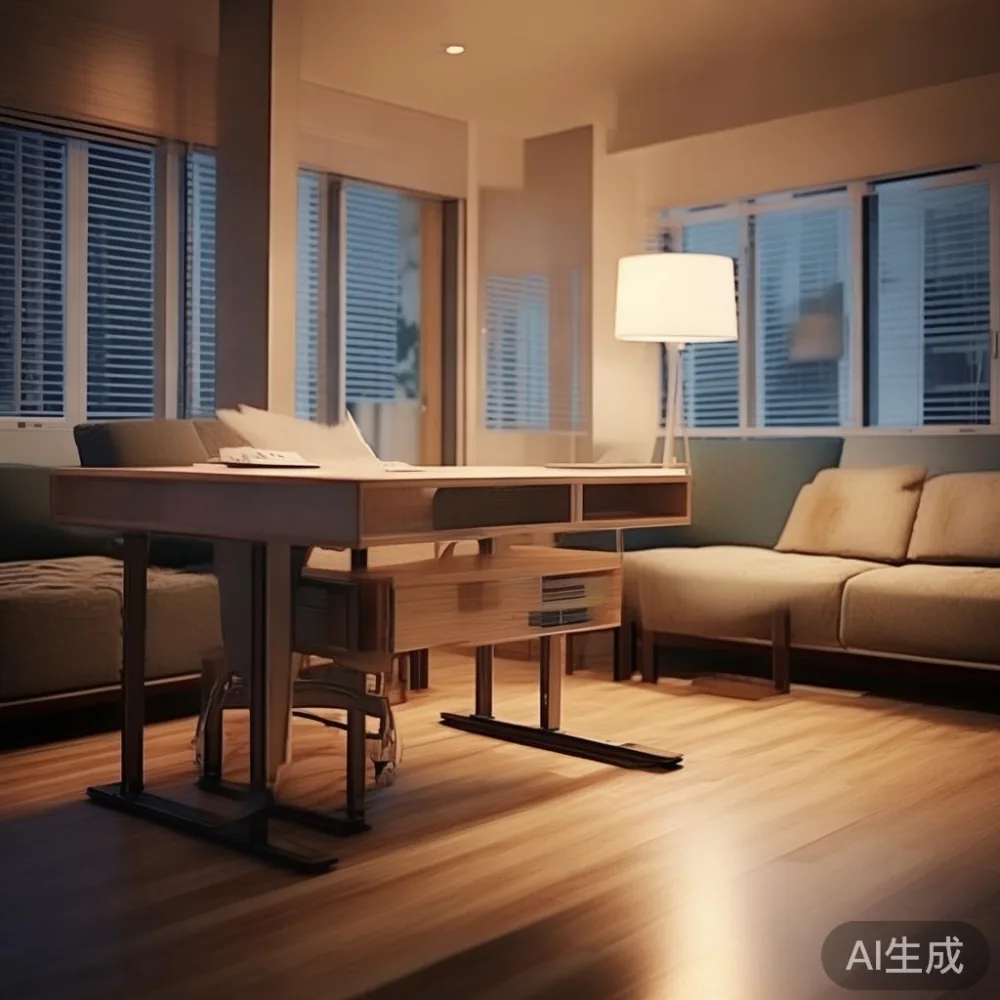
For a 5-room flat or executive HDB, expect 5 m by 3.8 m of living-dining space, sometimes flowing into an open kitchen. That extra 1 m of width changes everything: a 2.2 m three-seater sofa fits comfortably, a 1.6 m dining table seats six without elbows touching, and you can place a standing desk against the side wall near a window without blocking the French door. The pricing equation changes too. A solid wood sofa in walnut or ash starts near SGD 2,400 locally, but an Italian light luxury sideboard under 2000 from a direct-factory source like MIDHILL typically lands around SGD 1,800 delivered, including GST and lift-up service to your floor. Knowing the exact room envelope stops you from overspending on a piece that physically cannot enter the flat.
How do I measure my HDB flat so the furniture actually fits?
Pull out a steel tape, a pencil, and your phone. Start with the lift: most HDB blocks have lifts with an internal width of 1.1 m and depth of 1.4 m, but older blocks in Bedok and Toa Payoh can be as narrow as 0.9 m. Measure the lift door height too (usually 2.1 m), because a tall wardrobe of 2.2 m will not stand upright inside—you must tilt it, which requires the package diagonal to clear the lift ceiling. A 1.8 m wardrobe, by contrast, fits standing and saves fifteen minutes of awkward tilting in the corridor.
Next, walk every corridor bend from lift lobby to front door. Note the tightest turning circle, generally 1.4 m to 1.6 m for right-angle HDB corners. If your sofa is a modular L-shape with a 2.4 m long chaise, the diagonal across the assembled package may exceed 2.6 m and refuse to round the corner. A safer bet is a 2.0 m three-seater with separate ottoman, which travels as two pieces of 1.1 m by 0.9 m. For the standing desk, the frame alone (without the tabletop) usually arrives in a 1.3 m long box, well within lift limits, but the tabletop can be 1.5 m if you opt for a generous workspace. Order the tabletop separately from the frame if your lift is the narrow 0.9 m type, and you avoid the risk entirely.
How much clearance does a standing desk need around it?
A standing desk is not just a slab on legs. When the motor lifts the surface from 72 cm to 120 cm, your body still needs room to shift weight, lean forward, and rest one foot on a floor mat. Plan for at least 70 cm behind your chair for seated work and at least 30 cm of side clearance to the wall so the frame does not scuff the paint every time you raise or lower the desk. In front, leave 80 cm to 90 cm of clear floor so a 60 cm deep chair does not crash into the opposite wall or the back of your solid wood sofa.
If your living room doubles as the work zone, position the standing desk on the wall opposite the TV so you can pivot your chair 180 degrees and switch contexts without leaving the seat. A common Singapore layout is the parallel arrangement: sofa against one long wall, standing desk against the other, with a 1.2 m walkway between. For a 3 m wide room, this leaves just enough breathing space and still accommodates a 1.6 m dining table near the kitchen entrance. Many of the top 10 Modern furniture configurations published by regional design studios follow this dual-axis pattern, which keeps the standing desk as a permanent fixture rather than a temporary laptop perch on the coffee table.
Which sofa, bed frame, and dining table sizes work in 3 m, 4 m, and 5 m living rooms?
Let us anchor the numbers to three real HDB templates. In a 3 m by 3 m compact living room (typical of a 3-room flat), pair a 1.8 m two-seater solid wood sofa (about 0.85 m deep) with a 90 cm round marble table that seats two for dinner and three during the day. Skip the full dining set and use a wall-mounted fold-down table instead. The bed frame, if you also shop a replacement, should stay under 1.5 m wide—queen size compresses the room less than a king—and you can layer a wardrobe of 1.2 m wide rather than the standard 1.8 m. Expect to spend between SGD 4,500 and SGD 6,200 for this cluster, mattress excluded.
In a 4 m by 3.6 m mid-size room (the 4-room HDB classic), the comfortable target is a 2.1 m three-seater sofa, a 1.2 m by 0.7 m marble table, and a four-seat dining table of 1.4 m by 0.8 m. A queen bed frame (1.6 m wide) still fits in the adjoining bedroom, while the living room hosts a 1.4 m wide compact wardrobe along the side wall. Budget around SGD 7,800 to SGD 10,500 for sofa, dining table, marble table, and wardrobe, with the dining table taking roughly SGD 1,300 to SGD 1,900 of that total depending on the solid wood species.
For a 5 m by 4 m room (executive HDB or larger condo), pull out all the stops: a 2.4 m L-shape sofa with chaise, a 1.8 m dining table for six, a 1.4 m marble table, a standalone wardrobe of 1.8 m wide, and the standing desk of your choice. This is the room scale where a Rustic for guest room reading chair beside the window finally makes sense, because the guest can sleep on the daybed and still have a quiet corner to read without crowding the household. Prices climb to SGD 12,000 to SGD 18,000 for the suite, but you also have the air space to invite eight people for a gathering without anyone sitting on a side table.
Should I prioritise a standing desk over a traditional dining table in a small HDB?
If you work from home four days a week, the standing desk earns its keep faster than a dining table you only use twice a day. The decision comes down to daily hours spent. A person who logs 30 hours a week at the keyboard recovers the standing desk cost in roughly 14 months through fewer clinic visits for back and shoulder pain (an average of SGD 120 per physiotherapy session in Singapore, with most patients needing four to six sessions). A dining table, by contrast, returns value only on weekends and occasional dinners. So in a sub-3 m wide living room, replace the dining table with a 1.0 m round marble table on a slim pedestal and reinvest the saved square metres into a proper 1.2 m wide standing desk with a 60 cm deep tabletop.
That said, the dining table is a social anchor. Singapore families gather for dinner almost every night, and a 1.4 m table seats four comfortably with elbow room. A compromise layout uses a 1.2 m by 0.6 m wall-mounted table that folds down for dinner and collapses for the workday, freeing the standing desk to stand permanently. MIDHILL ships several extendable wall-mounted tables in solid ash that hold up to 80 kg when deployed, which is plenty for four adults and a pot of fish head curry. Their lifetime refinishing programme means the surface can be sanded and re-oiled after five years of daily use without buying a replacement.
What is the right way to shortlist solid wood sofa, bed frame, and wardrobe sizes before checkout?
Use a three-step filter. First, measure every doorway, lift, and corridor the piece must travel through. Anything wider than 1.0 m in any dimension must be split into modular sections, or you risk a SGD 80-150 redelivery fee when the driver cannot finish the job. Second, lay blue painter's tape on your living room floor at the exact footprint of each candidate piece. Live with the tape for 48 hours. Step around it, sit on a stool within the taped zone, and ask whether the walkway between the standing desk and the solid wood sofa feels comfortable at 0.7 m or pinched at 0.5 m.
Third, request the factory's packaging dimensions rather than trusting the product page. A solid wood sofa may advertise 2.2 m wide but arrive in three packages: one frame of 1.2 m, one armrest module of 0.6 m, and one seat-cushion box of 1.1 m by 0.4 m. Those numbers decide whether the boxes clear your lift and your corridor. The same applies to a wardrobe (typically two boxes of 1.0 m by 0.6 m and 0.6 m by 2.1 m) and a bed frame (two side rails and a headboard panel, none wider than 1.6 m for a queen). If you are looking at the top 10 light luxury furniture collections this season, ask the supplier for a packaging spec sheet. MIDHILL publishes these on request and includes them with every quotation, which removes the guessing game entirely.
How can I plan for a guest room without losing the standing desk space?
The guest room problem is the classic HDB squeeze. Most 4-room flats have one spare bedroom of roughly 2.7 m by 2.4 m. If you dedicate the whole room to guests, you lose the option of a dedicated workspace, so the standing desk migrates back to the living room and steals sofa space. The smarter move is a hybrid: a daybed of 1.4 m wide that serves as a sofa by day and a single guest bed by night, paired with a 1.2 m wide compact wardrobe and a 45 cm wide nightstand. A French provincial for guest room daybed in solid oak (around SGD 1,400 to SGD 1,900 depending on upholstery) holds its resale value, and the room still functions as a study when no one is staying over.
If your HDB does not have a spare bedroom, fold the guest function into the living room with a sofa bed rather than a dedicated daybed. A 1.8 m sofa bed in solid ash opens to a 1.4 m wide single mattress and stows flat against the wall at 0.6 m deep. That leaves the rest of the living room for the standing desk, a marble table for coffee, and a small dining area. The total spend stays under SGD 9,500 for sofa bed, standing desk, dining table for four, and marble table, which is roughly half the cost of furnishing a separate guest room that sits empty 340 nights a year.
How do delivery, GST, and warranty shift the final bill in Singapore?
Always calculate the landed cost, not the sticker price. Add nine percent GST on the imported value, plus a delivery fee of SGD 80 to SGD 180 depending on which floor your flat sits on and whether a stair carry is involved (corridor walks above the lift lobby add SGD 20 per 50 m). Free shipping usually kicks in above US$350, which translates to roughly SGD 470. Most Singaporeans clear that threshold with a single dining table or a pair of nightstands, so the delivery fee quietly disappears.
Then look at warranty terms. A 10-year structural warranty on a solid wood sofa protects the frame from cracking, joint separation, and major warping. The lifetime refinishing offer, available from suppliers like MIDHILL, covers sanding, re-oiling, and minor scratch repair for as long as you own the piece. In a humid climate where oak and ash can dry out within 18 months, that refinishing clause can save SGD 400 to SGD 600 over a decade and keeps the furniture looking new long after the warranty on cheaper flat-pack alternatives expires. Always request a soft-copy quotation that itemises the unit price, the packaging size, the delivery fee, the GST line, and the warranty scope before you confirm payment. The transparency lets you compare two factories accurately and avoids surprise charges on the day of arrival.
Final practical checklist before you tap checkout
Measure the lift internal width, the lift door height, every corridor corner, and every doorway between the lift and the living room. Sketch the room to scale and tape out the footprints of the solid wood sofa, standing desk, dining table, marble table, wardrobe, and nightstand. Confirm packaging dimensions for each piece, and verify whether each item fits inside the lift without tilting. Budget the landed cost with nine percent GST, lift-up service fee, and any stair carry for high-floor units. Cross-check the warranty terms, focusing on frame coverage and refinishing rights in tropical humidity. When all those boxes align and the numbers add up to a clean figure below your ceiling, the size was right and the purchase was sound.