Warm Minimal, Real Wood: Furnishing a Singapore Home Without the Cold
Warm minimalism is not a contradiction. It is the version of minimalism that survived contact with a Tampines four-room flat, afternoon sun on parquet, and a family that actually lives on the sofa. The cool, all-white, gallery-style version looks brilliant in a 280 sqm condominium showroom and falls apart by the second morning in a 90 sqm HDB where the lift is 1.0 m wide and the corridor turn is sharp. Warm minimalism keeps the discipline — few pieces, real materials, no visual noise — but swaps the cold palette for honeyed timber, sand, terracotta, oat, and unglazed stone. For a Singapore buyer, it is also the most practical version of minimalism, because every surface has to survive humidity that swings between 28 °C at 80% RH on a March evening and 24 °C dry after the air-con has been on for an hour.
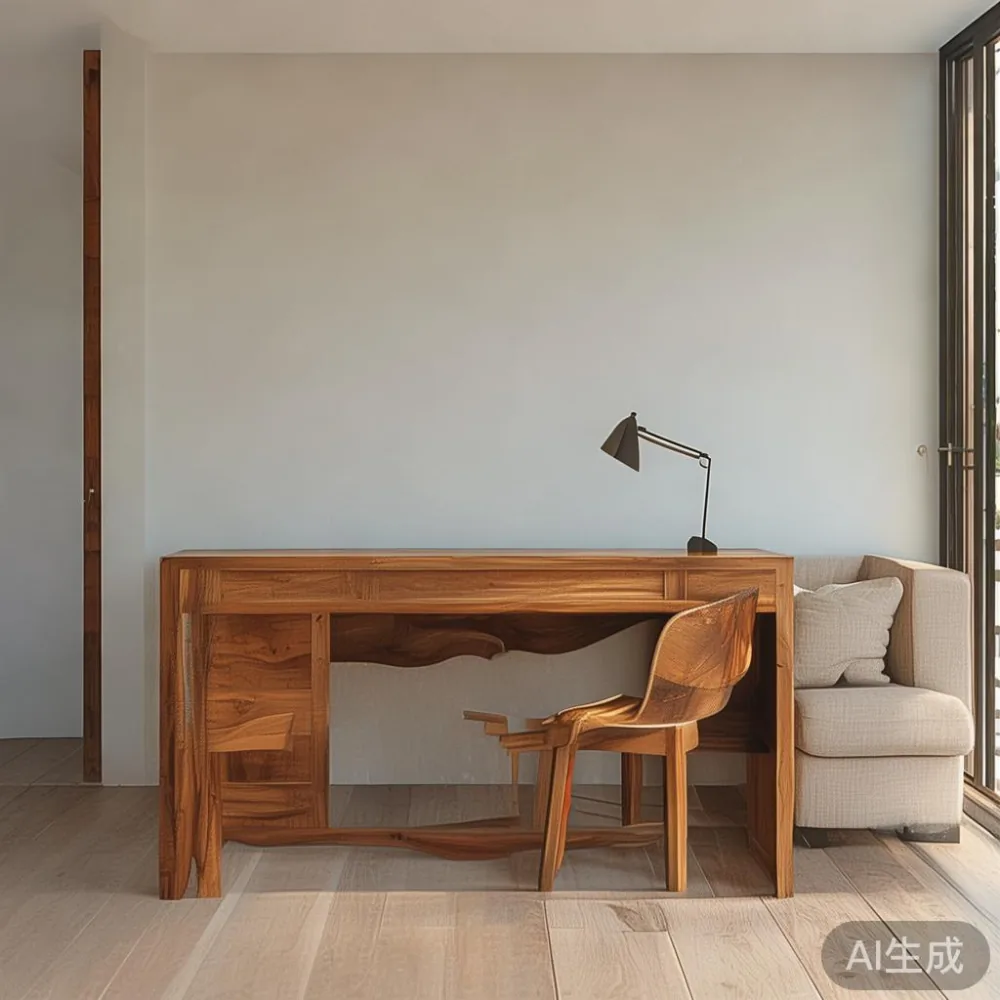
I tested this thinking last month in a Bedok 118 sqm resale condo. The owner had bought a strong, very fashionable Scandinavian-style setup — pale laminate everywhere — and asked me why the room still felt cold. We replaced only three things: a pair of thin side tables, a wardrobe facade, and the dining table. Each replacement was solid wood, each was under 2.1 m long to clear the lift, each came with a 10-year structural warranty, and the room stopped feeling like a hotel lobby in roughly two hours. The standing desk corner, in particular, reads warmer the moment the wood stops being oak-print.
What "Warm Minimal" Actually Means in a Singapore HDB
Warm minimal is a small set of rules, not a mood board. Concretely, it is:
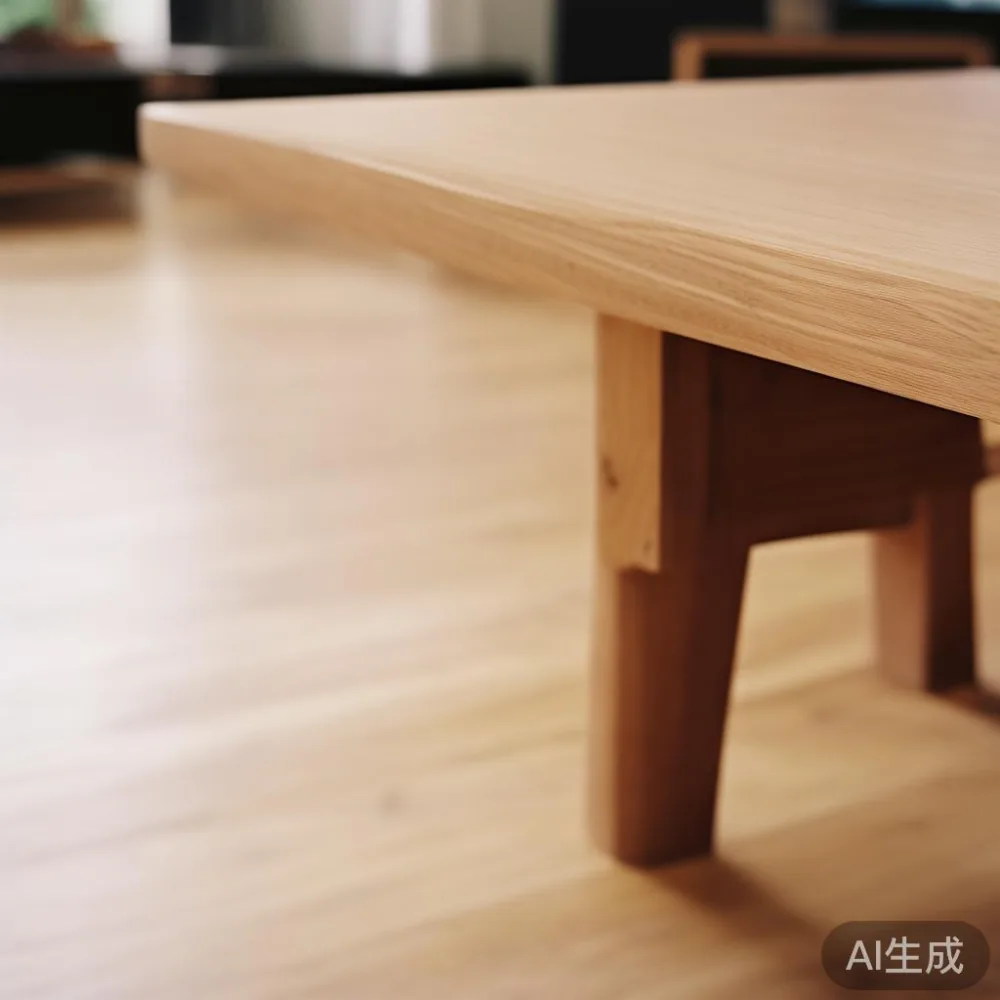
1. Two or three materials only, repeated — typically one light-to-medium solid wood (white oak, ash, beech, rubberwood), one matte stone or terrazzo accent, one woven or linen textile. Anything beyond three materials will fight the room.
2. Light values between 70 and 90 on the LRV scale — your walls and floors should sit in a narrow band. Differences are made with texture, not contrast. A pale oak floor at LRV 78 next to a lime-wash wall at LRV 86 reads warmer than a much darker floor at LRV 45, because the eye reads warm when the tone is even.
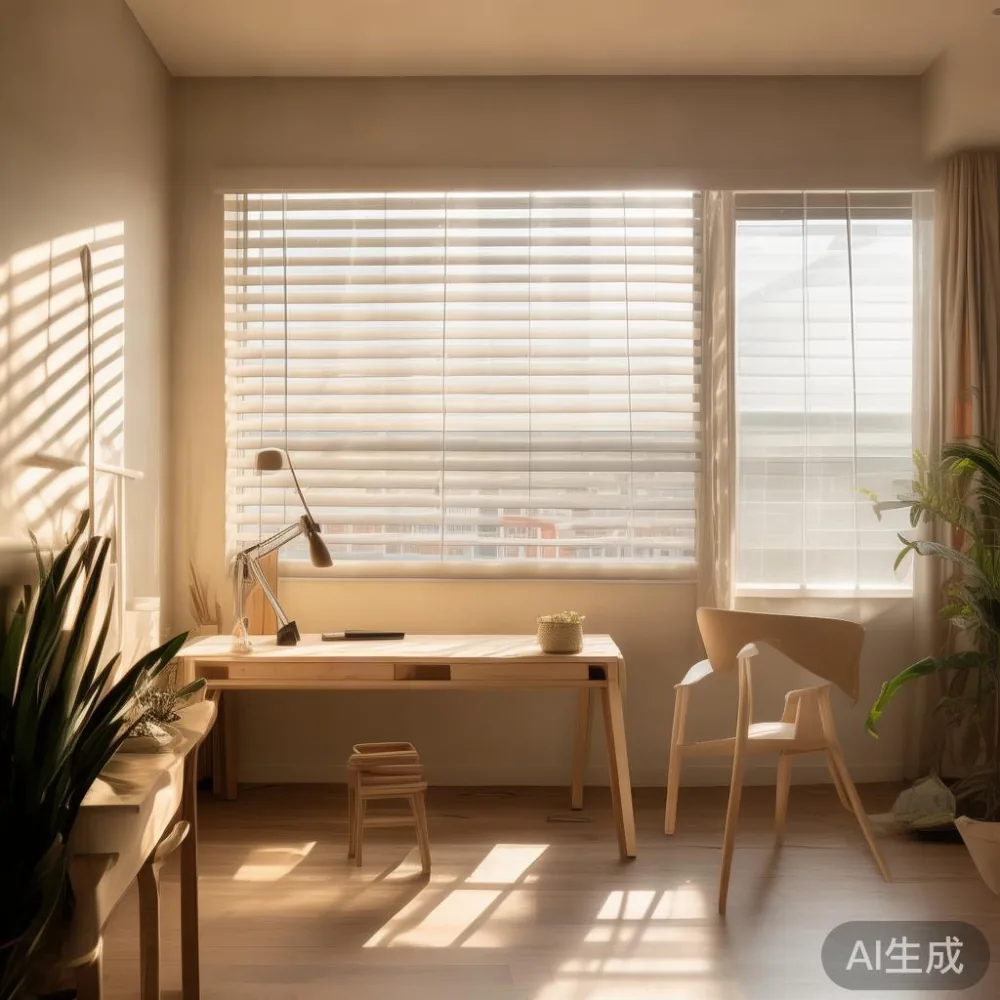
3. Real wood grain on at least one piece per sightline — this is where a solid wood sofa frame, a solid wood bed frame, or a dining table in solid timber earns its keep. Veneer prints repeat at 1.2 m intervals and the room immediately looks mass-produced.
4. No bare white LED strips — switch to 2700 K, 90 CRI, and you have done 60% of the warming work for under S$40 a fitting.
5. Curves, never ornate carving — warm minimal rounds the corners (a 12 cm radius on a dining table edge, a 4 cm radius on a wardrobe handle) instead of adding mouldings.
How Do You Keep Solid Wood Looking Right at 80% Humidity?
This is the question that decides everything in Punggol, Bukit Batok, or any HDB near the coast. Solid wood moves. Between December and April in Singapore, indoor relative humidity usually moves between 65% and 85% on days when nobody runs the dryer; in air-conditioned bedrooms it drops to roughly 45% at night. A 200 cm oak dining top can change width by 3 to 5 mm across that swing. If the table was built without allowance for that movement, you will see a hairline crack on the surface by week six.
What you actually want in the spec sheet:
- Quarter-sawn or rift-sawn timber for tabletops — they move less in width than plain-sawn boards. A Punggol homeowner I worked with last quarter replaced a plain-sawn beech table that had cupped 2 mm after one monsoon season with a quarter-sawn white oak top and the issue has not returned in seven months.
- Mortise-and-tenon or doweled joinery with elongated slots on at least one direction of each panel — this lets the wood slide sideways as it expands without splitting the joint.
- A moisture content reading between 8% and 12% at delivery — ask the supplier for the reading. Brands that kiln-dry to a target, not a range, will quote you the number without flinching.
- Hardwax oil or matte polyurethane finish — high-gloss lacquer shows every scratch in a Singapore afternoon. Oiled surfaces also let you sand and re-oil in place, which is a huge reason to ask about lifetime refinishing before you buy.
Storage pieces need the same discipline. A wardrobe is a slow heat exchanger between the room and the air trapped inside it; if the back panel is MDF or thin plywood, you will see bowing after one wet season. A wardrobe in solid timber with a 1.8 to 2.2 cm thick back, ideally shiplapped or with a frame-and-panel construction, is the minimum spec I'd accept for a Singapore bedroom. A solid wood nightstand in the same species keeps the room coherent and, at 45 to 55 cm tall, it also matches the standard Singapore bed-frame height of 50 to 60 cm — no awkward reaching at 2 a.m.
Is a Garage Storage Worth the Price in Singapore?
Yes — if it is solid wood, sized to HDB garage door clearance, and bought from a maker that ships it fully assembled or flat-pack with a labelled assembly difficulty for bedroom-grade furniture, because a complex wardrobe built in a 2.4 m wide garage corner is dramatically harder to dismantle than to assemble.
Two practical reasons. First, HDB garage storage can swallow items a bedroom cannot: out-of-season linens, suitcases, festive décor, golf clubs, and the spare standing desk you fold down at night. Second, garage cabinets in HDBs sit on a concrete floor that runs cooler and drier than the bedroom above, which means a solid wood piece actually survives better there than in a window-side wardrobe position. The honest calculation in SGD:
- A solid timber garage cabinet 120 cm wide × 45 cm deep × 200 cm tall from a Foshan maker like MIDHILL lands roughly between S$1,150 and S$1,600 ex- shipping, depending on internal spec (shelves, drawers, hanging rails).
- Free shipping threshold is typically US$350 (around S$475); below that, freight from Guangdong is usually US$120 to US$180 for a single pallet.
- GST is 9% on the landed CIF value above S$400 personal threshold (since 2024), so plan S$110 to S$150 extra on a S$1,400 item.
- Lift widths in most Singapore HDBs are around 1.0 to 1.1 m with a 2.1 m door height, which is fine for a flat-pack 200 cm cabinet but tight for a fully assembled one. Order flat-pack with labelled parts and the install is a two-person Saturday job.
The price is worth it when the cabinet does three jobs (storage, display, acoustic dampening behind the car) and you keep it for ten years. It is not worth it if you only own one car and the cabinet sits empty as decoration.
Wood, Stone, and the One Room That Earns a Marble Table
Warm minimal is not "no stone." It is "stone used like punctuation, not paragraphs." A marble table earns its SGD when it is the one cool surface in an otherwise warm room: a 90 cm round Carrara or travertine side table next to a solid wood sofa, or a 140 × 70 cm rectangular dining top with an unglazed edge. In a 93 sqm Punggol four-roomer, the single move that paid off for one client was replacing two fabric ottomans with one 45 cm travertine plinth table between a pair of low oak chairs. Total spend roughly S$780. Cooling effect on the room: noticeable. Cooling effect on the room in the wrong direction: zero.
Two rules of thumb for a marble accent in a HDB:
- Use unglazed or honed finish, never polished. Polished marble reads as cold and reflects the LED ceiling panel as a glare strip. Honed reads as stone, not as a mirror.
- Mind the weight. A 90 cm round travertine table at 3 cm thickness weighs 95 to 110 kg. Tiled HDB floor loadings are 2.5 kPa for bedrooms, 3.0 kPa for living, so a single point load of 100 kg distributed across four small felt pads is well within tolerance — but check before you buy a 1.6 m marble dining table, which can weigh 280 to 320 kg.
Pair stone with warm oak and you get the light-luxury / French / American light-luxury position taken seriously — not as a label, but as a quiet contrast. The post-modern light-luxury accent shows up when a single piece breaks the rectangular grid: a turned-leg armchair, a circular mirror, a low-slung lounge chair with a curved back. Two such moves per room is the limit; three becomes a theme park.
Can a Standing Desk Actually Fit a Warm Minimal Bedroom?
Yes — and it is the easiest piece to get wrong, because the standing-desk category is dominated by matte black steel frames that look like they belong in a Tampines BTO study, not a warm minimal bedroom. The room reads warm until the standing-desk cable tray shows under the edge of a beech top, and then it looks cold again.
What works:
- A wood-veneered or solid-wood top in the same species as the bed frame and nightstand. Spanning 120 to 160 cm wide and 60 to 70 cm deep, a 2.5 cm thick oak, ash, or beech standing-desk top keeps the room visually consistent. The steel frame can stay (steel at matte black is, by itself, neutral), but specify a closed cable channel rather than an open C-frame if you want a calmer sightline.
- Height memory of 65 to 125 cm is the medical sweet spot. At 168 cm tall, my preferred sit-to-stand ratio is roughly 105 cm standing and 72 cm sitting — get a frame that hits both without an extension kit. Frames rated for a 70 to 80 kg load handle dual-monitor setups comfortably.
- Acoustic floor mat, 90 × 60 cm, 1.5 cm thick, S$35 to S$55 retail. The frame is silent; the contact with the tiled floor is not.
- A credenza behind the standing-desk top, not beside it. A 120 × 40 cm credenza with solid doors keeps the printer and the cat's water bowl out of the line of sight.
One common Punggol floor-plan trick: convert the standing-desk position to a 140 cm wall opposite the solid wood bed frame. That gives you a 70 cm walking lane, enough for a wardrobe 60 cm deep with sliding doors to sit on the adjacent wall. Total study zone: 2.8 m², which is roughly what a single HDB bedroom corner typically allows after the bed and wardrobes are placed.
What Should "Light Luxury" Actually Cost in SGD?
Light luxury, French / American light-luxury, post-modern light-luxury — these are not pricing tiers. They are aesthetic positions. If a supplier uses them as a price justification, ask for the species, the joinery, the moisture content, the finish type, and the warranty in writing. Real numbers for a Singapore buyer in 2025:
- Solid wood bed frame, queen size, white oak or ash: S$1,400 to S$2,200 ex-shipping from a Foshan direct supplier. Slatted base included. Headboard upholstered in linen or leather: add S$280 to S$500.
- Dining table, 160 to 200 cm, six-seater, solid oak with extension leaf: S$1,200 to S$2,400 ex-shipping. Round 90 cm marble table: S$780 to S$1,400.
- Solid wood sofa, three-seater, hardwood frame with removable covers: S$1,800 to S$3,400. Anything cheaper and you are probably buying plywood.
- Wardrobe, 200 cm × 180 cm × 60 cm, flat-pack, solid timber panels with HDF backs: S$1,600 to S$2,800 delivered, including hardware and installation.
- Nightstand, two-drawer, 45 × 40 × 55 cm: S$280 to S$520 each.
- Standing desk, 140 × 70 cm solid-oak top with single-motor height-adjust frame: S$620 to S$1,050.
All of the above should comfortably clear free-shipping thresholds of US$350 (S$475) if you bundle to a container share. Allow 25 to 45 days from Foshan to your Tampines door, depending on consolidation; sea freight direct to Jurong typically adds 5 to 7 days over a Guangzhou → Singapore shared route.
The realistic total for a fully furnished warm-minimal three-room or small four-room HDB, with a 1.8 m solid wood bed frame, a 2 m wardrobe, a six-seater dining table, a solid wood sofa, two nightstands, a marble side table, and a standing-desk setup: S$9,500 to S$14,000 ex-GST, delivered. That is roughly half what an equivalent Singapore showroom package runs, with solid wood instead of veneer and a 10-year structural warranty in writing.
Buying Direct from Foshan Without Getting Burned
Three checks before you wire a deposit:
- Ask for the moisture content reading on the lot you're getting, not on a sample. Acceptable: 8 to 12%. Reject anything above 14%.
- Confirm the warranty terms in writing, including what counts as "structural" — a clear ten-year coverage on frame and joinery is reasonable. MIDHILL's published ten-year structural warranty sits in this range, and the lifetime refinishing offer is unusually generous versus the usual one-time resurface.
- Confirm the return path before the box arrives. A 14-day return on a flat-pack wardrobe is realistic; on a fully assembled dining table in a HDB corridor you basically cannot return it. Read the freight terms.
Two soft signals I'd also weight: how quickly the supplier answers technical joinery questions (under 24 hours, with drawings or photos), and whether they let you pay in stages — 30% deposit, 60% pre-shipment, 10% after delivery and inspection. Anyone asking for 100% upfront is farming photos, not furniture.
Putting It All Together in a 93 sqm Punggol Four-Roomer
Concrete layout, in words. Living/dining, 6.4 m × 3.6 m: solid wood three-seater sofa against the 6.4 m wall, 90 cm travertine round table to the left, 160 cm oak dining table opposite, two oak dining chairs spare to clear the circulation path. Common bedroom, 3.6 m × 3.2 m: 1.8 m queen solid wood bed frame centred on the 3.6 m wall, two nightstands at 50 cm height to match, 180 cm wardrobe flat-pack on the side wall with a 60 cm corridor between foot of bed and wardrobe doors. Standing desk against the remaining 3.2 m wall, 140 × 70 cm oak top, single-motor frame, credenza behind. Second bedroom: a single bed 100 cm wide, one nightstand, one 80 cm wide oak chest of drawers. Materials tally: oak, oak, oak, with a single travertine punctuation in the living room. Three materials total, including linen upholstery and the woven rug.
That is warm minimal in a HDB: it survives the lift, it survives the humidity, it does not pretend to be more than it is, and it stays quiet in the eye.